
NEUROACOUSTIC SCIENCE
What Is
Brainwave Entrainment?
Brainwave entrainment is the use of rhythmic auditory or visual stimuli to guide the brain's electrical activity toward a target frequency state. It's one of the most well-researched tools in neuroacoustic science — and the foundation of the Bio-Tuning® protocol.
The Science: Frequency-Following Response
The mechanism behind brainwave entrainment is called the frequency-following response (FFR) — a well-documented phenomenon in neuroscience where the brain's electrical activity synchronizes with a rhythmic external stimulus.
When you're exposed to a stimulus repeating at, say, 6 cycles per second (6 Hz), your brain tends to produce more electrical activity at that frequency. EEG measurements confirm this synchronization — the dominant brainwave frequency shifts toward the stimulus frequency.
The frequency-following response was first formally documented by Gerald Oster in Scientific American in 1973, and has been studied extensively since. Research has explored its applications in sleep, anxiety, attention, and pain management.
EEG-Verified Mechanism
Brainwave synchronization is measurable with electroencephalography — it's not subjective. Gerald Oster's landmark 1973 Scientific American paper formally documented the frequency-following response, and EEG studies have since confirmed FFR across multiple stimulus types including binaural beats, monaural beats, and isochronic tones.
40+ Years of Neuroacoustic Research
Dr. Jeffrey Thompson at the Center for NeuroAcoustic Research has applied and refined neuroacoustic entrainment protocols since 1988 — building on four and a half decades of clinical research across sleep, recovery, cognitive performance, and autonomic nervous system regulation. The Bio-Tuning® protocol is the direct clinical application of this body of work.
Three Primary Delivery Methods
Binaural beats, monaural beats, and isochronic tones are the three primary auditory entrainment methods. Bio-Tuning® uses binaural beats — requiring headphones — because they produce the entrainment effect through neural processing rather than as a physical sound wave. Each of your 21 tracks is a precision instrument calibrated to your fundamental frequency.
American Journal of Biomedical Science & Research
The frequency-following response is not a fringe claim — it has been studied since Gerald Oster first documented it in Scientific American in 1973, and subsequent peer-reviewed research has demonstrated measurable effects on anxiety, vigilance, and cognitive performance.
How Binaural Beats Work
Binaural beats are the primary delivery method in Bio-Tuning® audio tracks. Here's the mechanism:
Requires headphones — the beat exists only in the brain's processing
The binaural beat frequency — the difference between the two tones — is what the brain entrains to. Critically, this beat doesn't exist as a physical sound wave. Peer-reviewed research confirms the beat frequency appears in neither the spectrum nor the envelope of either stimulus tone. The brain doesn't detect it. The brain generates it.
Play 200 Hz from one speaker and 206 Hz from another. The sound waves physically collide in the air, producing a real, audible 6 Hz pulse in the room. Both ears hear it simultaneously. This is a monaural beat — a physical acoustic event that exists outside the brain.
Why the brain synchronizes
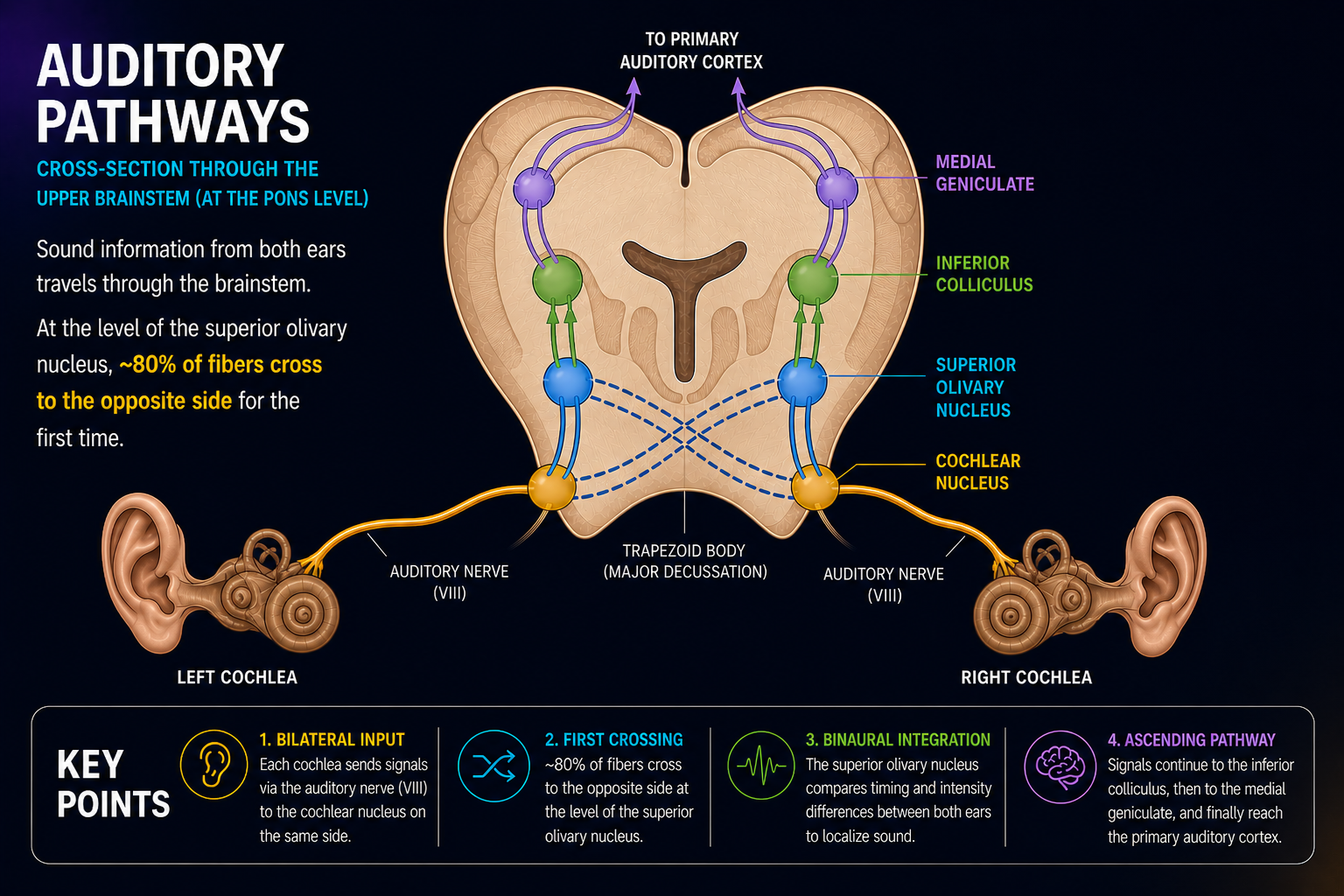
Under natural acoustic conditions, both ears always hear the same acoustic environment — frequencies arriving from the same physical space, mixed before they reach the skull. Headphones change this fundamentally. Each cochlea receives a completely isolated signal. There is no acoustic mixing, no air-wave collision, no shared physical beat. The brain has no evolved template for resolving two different tones arriving separately to each ear.
The auditory pathway is illustrated above. Sound from each ear is first processed at the Cochlear Nucleus — an independent relay station in the brainstem that handles timing and intensity per side. From there, roughly 80% of fibers cross to the opposite hemisphere via the Trapezoid Body, converging for the first time at the Superior Olivary Nucleus. This is the earliest structure in the auditory pathway to receive simultaneous input from both ears — and the site where the brain detects the frequency discrepancy and synthesizes the phantom beat. Neither ear delivered it. The brain manufactured it entirely from the difference.
The signal then ascends through the Inferior Colliculus — a midbrain relay critical for sound localization and timing — to the Medial Geniculate Nucleus of the thalamus, and finally to Primary Auditory Cortex. The entire ascending pathway, from cochlea to cortex, locks to the beat frequency the brain itself produced. Because both hemispheres must cooperate to process what neither ear delivered alone, this drives inter-hemispheric synchronization — and because the brain manufactured the beat, it begins to time its own electrical rhythms to it. The frequency-following response — from the inside out.
Binaural Beats Woven Into Music — Not Layered Over It
Conventional binaural beat products are built from two raw sine waves — pure synthetic tones, artificially detuned and placed underneath ambient sounds. The listener can often perceive the result as an unnatural, mechanical pulsing that sits in acoustic contrast with the music on top.
Dr. Jeffrey Thompson pioneered a different approach beginning in the 1980s: rather than generating two sine waves and calling it done, the binaural entrainment frequency is woven directly into the overtone harmonics of actual instrument sounds. The music itself carries the entrainment. The binaural effect is embedded in the natural harmonic structure of the tones — transparent to the ear, coherent with the acoustic field, and neuroacoustically integrated in a way that raw sine waves cannot achieve. You hear music. The entrainment works like precision science. You are never consciously aware of the mechanism.
The Full Brainwave Spectrum
The brain operates across a far wider spectrum than most people realize. Most consumer entrainment apps cover only Delta through Beta — four states. Bio-Tuning® programs span the complete known spectrum, from sub-Delta Epsilon through Gamma, HyperGamma, and Lambda — frequencies first documented by Dr. Jeffrey Thompson at the Center for NeuroAcoustic Research and later independently confirmed in multiple PubMed research articles.
The slowest conventional brainwave state. Associated with deep, dreamless sleep, cellular repair, immune function, and physical recovery. Delta is where the body does its deepest restoration work. All Bio-Tuning® Level 1 programs begin here.
The threshold of dreaming sleep (REM sleep). Associated with shamanic journeying, Aboriginal Dreamtime, deep meditation experiences, hypnagogic states, emotional processing, intuition, and access to subconscious material. Creativity and creative insights are associated with Theta brain activity.
The bridge between rest and active thinking. Associated with peripheral vision and holographic thinking, relaxed alertness, calm focus, Zen-type meditation, and integrative thinking. Where Beta sees a tree, Alpha sees the forest. (The Flow state itself sits at the Alpha/Theta border, not pure Alpha.)
Sensorimotor rhythm (SMR, 12–15 Hz) and Beta (15–30 Hz) are associated with alert, focused attention. SMR in particular supports calm, stable focus without anxiety. Most generic entrainment apps stop here.
Most entrainment apps stop at Beta. Bio-Tuning® programs continue through Gamma, HyperGamma, Lambda, and sub-Delta Epsilon.
Gamma is associated with peak cognitive performance, cross-brain integration, and universal empathy — observed in advanced meditators studied at the University of Wisconsin. The only brainwave that disappears under general anesthesia, therefore associated with cognitive consciousness. Also called the 'binding' frequency: Gamma modulates with Theta and binds the information from all 5 senses together, synchronizing them in a wireless 'internet' of the brain.
First discovered during open brain surgery in the mid-1980s, alongside Gamma and Lambda. First researched and documented clinically by Dr. Jeffrey Thompson at the Center for NeuroAcoustic Research in the late 1980s. Associated with intense perceptual clarity in advanced meditators. A Level 3 Revelation track — exclusive to the high-tech meditation category of the Bio-Tuning® program.
Among the highest brainwave frequencies ever discovered in human research — first researched and documented clinically by Dr. Jeffrey Thompson in the late 1980s. Lambda entrainment is consciousness-expanding and exploratory, opening into new arenas of consciousness research. Available exclusively in the Level 3 high-tech meditation category of the Bio-Tuning® program.
Below the lowest conventional Delta. Discovered by Dr. Jeffrey Thompson in 1989 at the Center for NeuroAcoustic Research — at the time, the slowest brainwave frequency ever documented, a record held until the Default Mode Network was identified in 2001. Associated with metaphysical experiences in advanced practitioners: out-of-body sensations, precognitive impressions, and deep epiphanies. Requires completion of Levels 1 and 2.
Why Generic Brainwave Apps Fall Short
Most consumer brainwave entrainment products use fixed frequencies — the same 6 Hz Theta tone for every user. The problem is that the frequency-following response is strongest when the target frequency is harmonically related to the brain's existing dominant frequency, which differs between people.
Bio-Tuning® addresses this by measuring each client's fundamental frequency — a biological measurement derived from heart rate variability (HRV) analysis — and using it to calibrate the binaural beat frequencies in their audio tracks. The result is entrainment that works with your nervous system rather than applying a generic template to it.
Frequently Asked Questions
Answers to what we hear most often about binaural beats, safety, and how Bio-Tuning® compares to generic entrainment tools.
Get Started
Experience Personalized Entrainment
A certified Bio-Tuning practitioner measures your fundamental frequency and builds a personalized 21-track program calibrated to your biology.
Research foundation: Center for NeuroAcoustic Research — Dr. Jeffrey Thompson. Neuroacoustic research since 1988.